.jpg)
A Procurement Researcher’s Guide To Transition to Digital Services in Assuredly Liberal Democracies
Published:
 Feeling free on a hike to McClure Rock, Washington.
I love America. I love American culture, and most importantly, Americans. Growing up in Germany, my high school taught me to read both the German Constitution and the Constitution of the United States. When Nazi-Germany had ended, the United States (quite directly) helped to rebuild a free, democratic Germany. I had never perceived a US government as hostile to the values I held dear. But sometime last year, this changed.
Trump and Vance have successfully implemented administrative reforms that reconfigured the inner workings of the public sector. Revised laws that formerly enabled independent agencies. Canceled and re-awarded enormous government contracts. Reconfigured ICE into a cross-cutting force in a federal system. Trump and Vance are working towards a new America.
But why do I — as a German living in Belgium — care so much about these reforms?
As a former analyst of large-scale government IT systems and PhD candidate who studies strategic public procurement, I know how important the inner workings of the public sector are. My anxiety about Trump and Vance’s new America came from an unconscious realization: I was completely exposed to the current administration. All my digital services were based, hosted or managed in the United States.
The current administration could influence which news, search results, or genAI responses I would see. The new administration could reduce the visibility of my posts and content. But most worryingly, the new administration could easily remove access to almost all of my digital services — my email, messaging apps, or data stored on my drive.
What would happen to me if I could not longer access my email account or all my personal and professional data stored in the United States? Here lay the root of my long-lasting anxiety. The emotion of fear was telling me something, but I had somehow managed to deny the information it was giving me for almost a year.
By procuring all my digital services from the US, I was now in a position of great vulnerability. To reduce my anxiety, I had to reduce my vulnerability. Within a single week, I moved all my digital services to assuredly liberal democratic countries.
Why transition toward digital services in assuredly liberal democracies?
My case for procuring digital services from European and Western liberal democracies is about risk management. When communication, productivity, entertainment, and payment services are provided by firms that are all headquartered in, say, the United States or China, Europeans inherit legal exposure (surveillance and disclosure regimes), political exposure (silent steering, sanctions), and economic exposure (lock-in, platform decay).
The more central the service is to my daily life, the more critical my personal dependency on a foreign jurisdiction becomes. For many Europeans, shifting toward Western and European providers is comparable to diversifying supply chains in energy or defense: the transition reduces single-point vulnerability.
But there is another reason to transition toward non-US and non-China services, which I only became aware of while making the switch. Many alternatives from assuredly liberal democratic countries offer superior engineering at lower prices. Per month, I now save €40. This was quite shocking to me. But it makes sense. Personally, I had not switched digital services in more than a decade. This holds true for pretty much everybody I know. Which competition was going to incentivize the incumbent providers to do better? None.
My transition strategy: jurisdiction and comfort first, then decentralization, then open-to-inspection
My strategy was to prioritize jurisdiction and data residency above everything else. The decisive question is: which legal system governs the operator and where is the data stored and processed? Open source is valuable, and decentralization is powerful, but neither automatically fixes jurisdictional risk if the operational control, billing entity, or hosting footprint sits outside of assuredly liberal democracies. Conversely, a proprietary service can still be a strong “sovereignty upgrade” if it is based in an assuredly liberal democracy and contractually clear about data handling.
Because the ease and comfort of using digital services matters tremendously, I consciously prioritized solutions in assuredly liberal democracies that are well engineered and easy-to-use. As you will notice, some European and Western providers offer proprietary solutions that are not open source, but just as easy-to-use as solutions by Google 🇺🇸.
Many tech geeks get this wrong by the way. They believe that some specifically designed digital infrastructure is per se safe and immune against capture. But without a liberal democracy, no such technology will function well. I am not arguing that some technological designs do not lend themselves better to a liberal, democratic society. But the functioning of any technological design strongly varies with the administrative and legal environment of the jurisdiction within which the design is implemented.
This is why we should opt for technologies that naturally allow for decentralization across jurisdictions. Email is one such technology. If your email account is blocked, you just open another one elsewhere. Decentralization reduces platform capture by allowing multiple providers to run interoperable servers — more like email than like a single centralized app.
Another important principle is to buy software that is open-to-inspection (open source). This enables independent security reviews, and makes exit options more credible (because other firms can continue developing the code, even if the main player exits or changes policy).
Several ecosystems align with these three strategic principles: the Fediverse (interoperable social platforms that use the ActivityPub protocol) and the Matrix (a federated real-time communication protocol for messaging apps). In both cases, the user can choose a provider within the jurisdiction of their preference, without being cut off from the wider network. This freedom to choose creates a robust market that disciplines providers and reduces lock-in. One can see the similar market principles at work in Linux-based operating systems such as openSUSE.
By now, you may have noticed that I am a classical liberal. I believe that we can learn from the last few centuries that functioning markets are a bedrock of liberty. This is why we need European and national regulation that enables competition and dismantles monopolies in markets for digital services. Again, this is about getting your priorities straight: there is no privacy without liberty.
A guide for transitioning
So how did I do it? In this brief guide, I would like to show how anybody, including non-tech-savvy people can reduce their vulnerability. Prioritization is key. I started my transition with the most critical digital services.
Tier 1: very critical digital services
Identity, email, security, data
Imagine you no longer have access to your emails. Also those decades of documents, scans, photos on your drive — they are out of reach for you now. All your passwords are now known to the current US government.
Google Mail 🇺🇸, Google Drive 🇺🇸, Google Docs 🇺🇸, LastPass 🇺🇸, ExpressVPN 🇻🇬 → Proton 🇨🇭
Google is a US corporation. LastPass is a US-based password manager under a US corporate group. Proton is headquartered in Switzerland. It has consolidated a range of identity and security tools, structured around European legal expectations. It offers a seamless suite of solutions from email to VPN. It allows to import data from Google and LastPass accounts with just a few clicks. I love Proton so far. Highly recommended.Home security: Amazon Ring 🇺🇸 → Homematic IP 🇩🇪
Amazon Ring is a US-hosted Amazon service; Homematic IP is developed by eQ-3, a German, family-owned company headquartered in Leer. The Homematic IP system launched in 2015, with development and servers in Germany. Their system is also known for robust 868-MHz style smart-home reliability and a very wide hardware device portfolio. Practically speaking, our new security system is more secure, since the siren is located on the ceiling and can’t be simply ripped off and stepped on by an intruder (unlike Amazon Ring).
Operating systems
Imagine you wake up one day and you no longer can use your phone or PC. You were locked out and you cannot login anymore.
Android 🇺🇸 → GrapheneOS 🇨🇦
Android is developed under Google’s US corporate umbrella; GrapheneOS is a security-hardened Android-compatible OS project. Engineering quality is high in its niche (hardening, fast security updates). I was most worried about this transition step, by the way. Especially replacing the Google operating system with the GrapheneOS operating system on my Pixel phone. But that worked like a charm. Just had to read the official GrapheneOS website and click on some buttons.So far, not a single app has had an issue on GrapheneOS. Quite impressively, my data subscription uses considerably less data on GrapheneOS, even though I am using exactly the same apps as before. Highly recommended.
Windows 🇺🇸 → openSUSE Tumbleweed 🇩🇪
Windows is a Microsoft product; openSUSE is a community Linux distribution associated with the SUSE ecosystem. The sovereignty win is increased inspectability and reduced platform dependence. openSUSE Tumbleweed has been running perfectly on my private notebook with a touch screen. In fact, it is faster and more stable than MS Windows was. I think that the performance difference here was most pronounced among all the transitions I’ve made. openSUSE Tumbleweed just runs much smoother and faster on my device.
Messaging
- WhatsApp 🇺🇸 → Matrix 🇬🇧
WhatsApp is owned by Meta; apps like FluffyChat and Element use the Matrix protocol. Engineering quality: WhatsApp is highly centralized and increasingly mined by genAI applications; Matrix is the strategic alternative where federation and provider choice are possible. I wanted to use an application on the Matrix protocol because the freedom to choose providers is more important than assurances by centralized service providers about my current or future privacy.
Tier 2: critical digital services
Productivity and collaboration
Microsoft Office 🇺🇸 → LibreOffice 🇩🇪
Microsoft Office is a flagship Microsoft suite; LibreOffice is a major open-source office suite stewarded by a German foundation. LibreOffice is excellent for standards-based documents and offline work. So far, I never encountered a moment where I would have needed MS Office.Microsoft Teams 🇺🇸 / Google Meet 🇺🇸 → Element 🇬🇧
MS Teams and Google Meet are US-based. Element is a UK company building on the Matrix protocol (initiated in 2014). Engineering quality: Element is strong in terms of interoperability, self-hosting, and auditability, but MS Teams is the legacy solution at my employer.
Browser, search, and maps
Google Chrome 🇺🇸 → Vivaldi 🇳🇴
Chrome is a Google browser; Vivaldi is a Norway-based browser company. Engineering quality: Vivaldi is more power-user friendly and feature-rich than Chrome. Vivaldi is “Chromium-based”, which I prefer over Firefox-based browsers.Google Search 🇺🇸 → Ecosia 🇩🇪
Google Search is subject to US-jurisdiction; Ecosia is a Berlin-based search engine positioned around privacy and social impact. Next to the general indexes, Ecosia also uses the European Search Perspective, which improved my user experience with regards to local (European) topics.Google Maps 🇺🇸 / Waze 🇺🇸 → HERE WeGo 🇳🇱
Google Maps/Waze are Google-owned; HERE WeGo is headquartered in the Netherlands. Engineering quality varies by city and use case: Google still dominates point-of-interest richness; HERE WeGo is excellent for navigation when using public transport or going by car.
Tier 3: somewhat critical services
Entertainment
Some may wonder why I group entertainment services among somewhat critical services. Think of the ‘documentary’ about Melania, which will soon be streamed on Amazon Prime and other US-based streaming providers. This is one early example of using soft power in the service of Trump and Vance’s vision of a new America. I do not want to be gently influenced to align with this vision. No man is an island entirely of itself. Eventually, if I keep watching streaming services that push this vision, I will be influenced and adapt.
Apple TV 🇺🇸 → Formuler 🇰🇷
Apple TV is subject to US jurisdiction; Formuler is top-notch Korean hardware. I like that I have more choice on my Formuler device. The remote control of Formuler is much nicer to use than the Apple TV one. YouTube and Netflix have given Formuler the cold shoulder — they have not “accredited” the use of their apps on Formuler. With all the genAI slop and now bizarre content on YouTube, I do not use it anymore. I use a more restricted version of Netflix on my Formuler streaming box. My European apps work perfectly — Streamz, the public broadcaster apps, CineMember, etc.Amazon Prime Video 🇺🇸, Netflix 🇺🇸 → CineMember 🇳🇱
Netflix and Prime are US-based services; CineMember launched in 2018 as a platform for European movies and series. I often wanted to watch series like “Borgen” or “Eldorado KaDeWe”, or just movies produced and widely distributed in Europe and Asia. I very rarely found what I was looking for on Netflix, HBO, Apple TV, or Amazon Prime. CineMember really solved my problem of finding that type of content. I also did not want a very arthouse, artistic content provider like Mubi. So CineMember is like the shoe that fits, finally. Also, the navigation and loading speed of the app are great.Apple Music 🇺🇸 / Audible 🇺🇸 → Spotify 🇸🇪
Apple Music and Audible are US services; Spotify is Swedish (incorporated in Luxembourg, operational HQ Stockholm). Spotify’s discovery and cross-device support are strong. Also, their audiobook assortment is on par with Amazon Audible now.
Shopping and travel
Amazon Shopping 🇺🇸 → Bol 🇳🇱, Coolblue 🇳🇱
Amazon is subject to US-jurisdiction; Bol is owned by a Dutch retail group and Coolblue is a Dutch private company with a disclosed shareholder structure. Bol and Coolblue offer outstanding customer service and quality and local support. The vast chunk of my online shopping can be done on Bol and Coolblue.Airbnb 🇺🇸 → HomeToGo 🇩🇪, Holidu 🇩🇪
Airbnb is US-based. HomeToGo and Holidu were both founded in 2014 in Germany. HomeToGo and Holidu are aggregators with more listings than Airbnb. However, unlike all other digital services listed in this article, I have not yet booked a place via those apps.
Tier 4: non-critical services
Learning and reading
Goodreads 🇺🇸 → The StoryGraph 🇬🇧
Goodreads is a US-based service owned by Amazon; The StoryGraph is registered in London. StoryGraph offers good statistics and recommendations. I really believe that we only used Goodreads because most users are on Goodreads. Maybe Goodreads was the first example of platform decay, way before YouTube and Twitter.Kindle 🇺🇸 → paper books
Kindle is an Amazon device line that began in 2007; switching to paper is the ultimate “offline and jurisdiction-independent” move. After many years I can confidently say: I almost always prefer to read on paper.
Socials
The social media alternatives listed here are all part of the Fediverse. I do not use Instagram 🇺🇸 or TikTok 🇨🇳, but I know that there are more user-friendly (and far less toxic) alternatives from the Fediverse, such as Pixelfed 🇨🇦 and Loops 🇨🇦.
Reddit 🇺🇸 → Jerboa 🇫🇮 / Lemmy 🇩🇪
Reddit is a US platform; Jerboa is an app to engage with the federated content in the Fediverse using Lemmy. Reddit still has enormous content gravity, but also increasingly toxic conversations and a strong drift to the topics that the new US administration cares about. Jerboa 🇫🇮 / Lemmy 🇩🇪 offer normal conversations and a wider range of topics, probably due to its federated architecture and community autonomy.X 🇺🇸 → Mastodon 🇩🇪
X is US-based and privately owned (per current structure); Mastodon began in 2016 as an open-source decentralized alternative. Mastodon is easy to use, but has fewer users than X used to have. I now prefer it over Bluesky because it cannot be captured and is not based in the US. Mastodon is technically elegant, but the mass of users and content is tiny compared to X.YouTube 🇺🇸 → PeerTube 🇫🇷
YouTube is US-owned; PeerTube is open-source, federated, and supported by a French nonprofit ecosystem (with stable releases from 2018). PeerTube is technically elegant (federation + peer-assisted distribution) but the mass of content on PeerTube is tiny by comparison.
The very few digital services that I already purchased from European providers
Anti-virus: Bitdefender 🇷🇴
Bitdefender is a Romania-based cybersecurity firm (privately held). Bitdefender has a long track record in endpoint protection and generally scores well on detection and performance, with mature Windows/macOS clients and strong enterprise pedigree.Clothes: Zalando 🇩🇪
Zalando is a European public company headquartered in Berlin. Engineering quality: logistics, returns, and EU-wide operations are mature. I’ve never had any return issues with them. Works perfectly.Smart thermostat: tado° 🇩🇪
tado° was founded in Munich in 2011, with early products launching in 2012. Strong app experience and energy-management features.
Digital services that are currently irreplaceable
Three types of services remain difficult to replace without losing functionality and comfort.
The first is payment technology — a very critical digital service. Mastercard 🇺🇸 and Visa 🇺🇸 and Google Pay 🇺🇸 are irreplaceable at the moment. This will change within a year. Wero 🇪🇺 will be integrated in the apps of most banks in Europe soon. But there is an even more radical sovereignty solution on the horizon. A future digital euro, issued by the European Central Bank, will allow users to handle most (by number of transactions, not by monetary value) transactions without intermediaries.
The second is genAI. I have not yet found a viable European-owned alternative to Google Gemini 🇺🇸, OpenAI ChatGPT 🇺🇸 or Claude 🇺🇸. I wish that Proton Lumo 🇨🇭 or LeChat 🇫🇷 attained the same performance level, but they don’t. To my knowledge, private firms in Europe cannot produce LLMs at the same price point as competitors in the US and China (a cost problem, not a capabilities problem).
The third is LinkedIn 🇺🇸: careers, recruiting, and public professional conversations are concentrated there. European alternatives do not yet offer comparable global reach or opportunities.
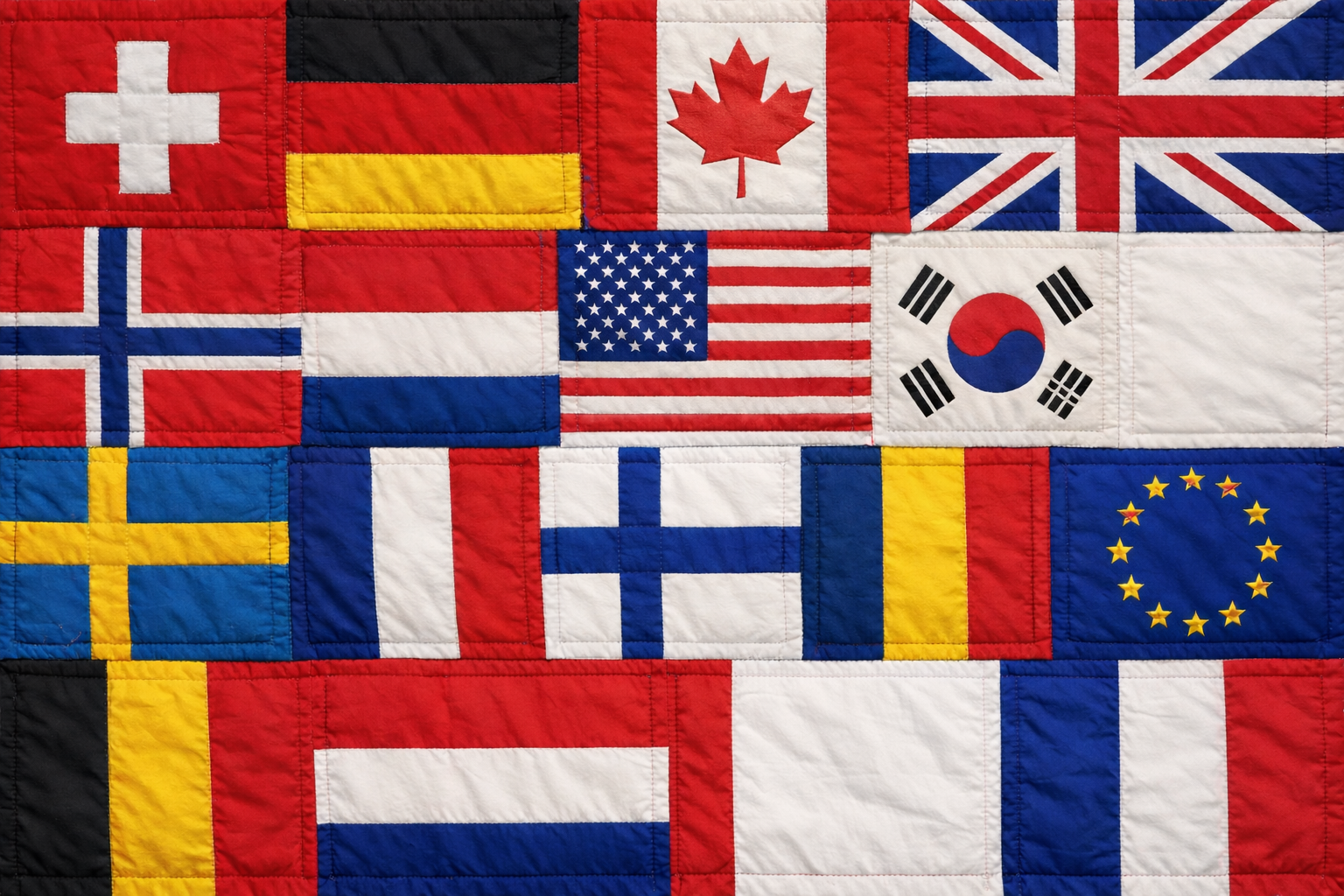 A quilt of all the countries that I procure digital services from. White space symbolizes potential other countries. The US flag remains snuggly in the middle of its allies, where I believe it should be.
How I feel now, after the transition
I feel great! The relief and absence of anxiety is priceless. I wish I had done this much sooner. That is why I wrote this blog post. Perhaps it will provide others with the knowledge to get started with their transition and reduce their anxiety.
There are many readily available, better-engineered and cheaper solutions out there — from firms and organizations based in assuredly liberal democratic countries. So don’t waste your time being anxious about things that you can change. You can change how exposed you are to Trump and Vance’s new America.
PS: My transition is not yet complete. For example, I still need to migrate my code repositories from GitHub 🇺🇸 to Codeberg 🇩🇪. But it’s not about perfection. My transition so far has been sufficient to lift the veil of anxiety I had been living under for the last year.